Mahjong Ways 2: Gold Tiles, Wilds and Free Spins
Mahjong Ways 2 is a video slot with mahjong-tile imagery, five reels and a middle section taller than its outer reels. Its defining reading task is to follow gold-plated symbols becoming Wilds after qualifying wins, while a separate multiplier changes through a cascade sequence. This reference uses PG SOFT’s version 1.0r792 game-information PDF and its official sequel announcement; it does not describe the rules of the table game mahjong. [mahjong-pdf][mahjong-news]
Recognise the stepped reel layout
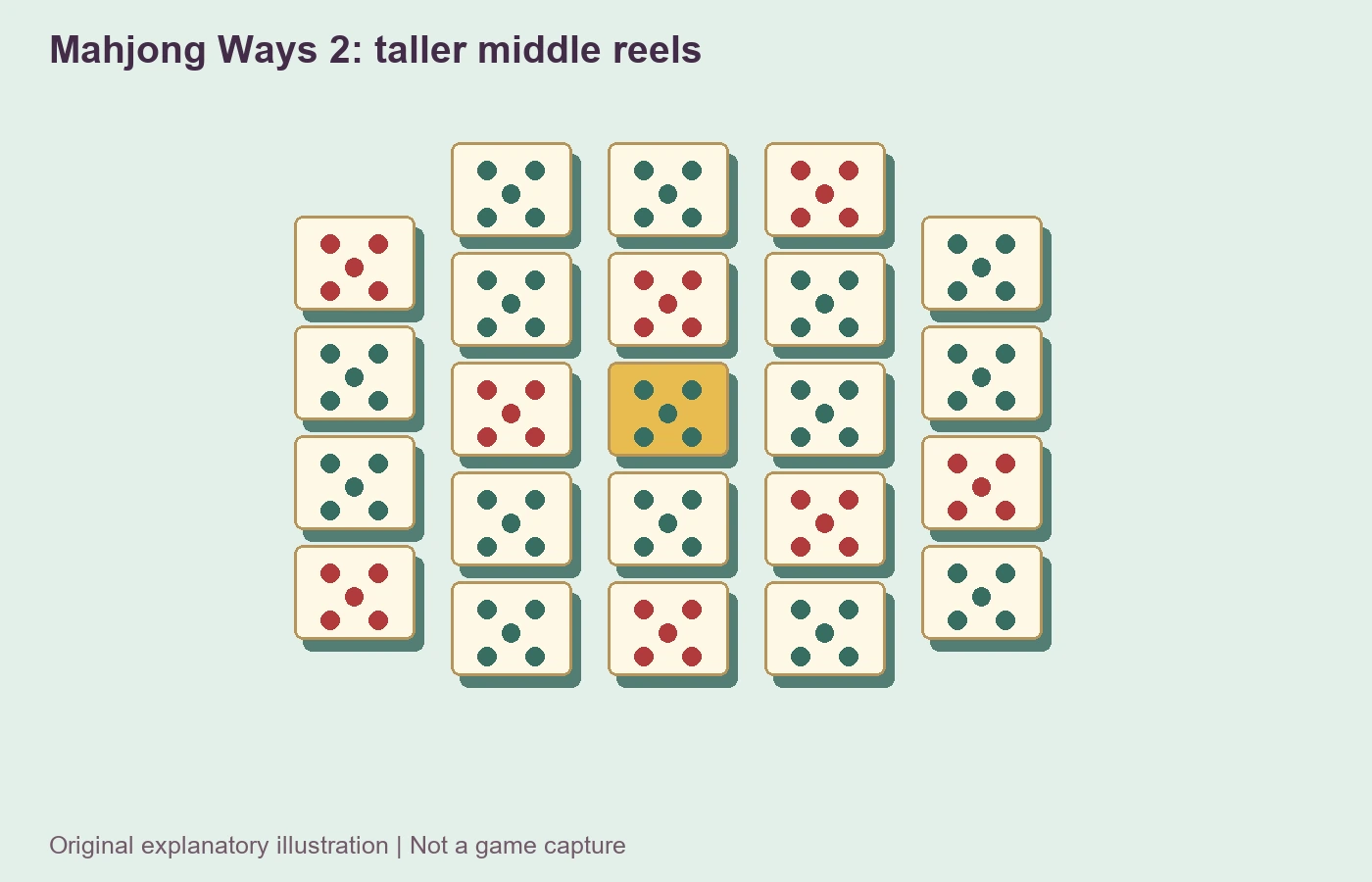
- Documented definition
The layout has four rows on each outer reel and an additional row on reels two, three and four. PG SOFT’s specification labels the game as offering 2,000 ways. The stepped silhouette in the first illustration makes the extra middle positions visible, instead of flattening the game into an ordinary rectangle. [mahjong-pdf: sections 1.1–1.2]
- Reading the illustration
A reader can identify five vertical columns before trying to follow a combination. This prevents the decorative tile faces from obscuring the display’s underlying structure. The illustration includes original tile markings but no payout values. Its role is to show where symbol positions exist, not to substitute a homemade paytable for the publisher’s information.
- Interpreting the state
The number of rows is a layout description, whereas the ways label describes the documented evaluation structure. Those ideas should not be confused with the number of winning results a particular spin will produce. A full display contains many visible positions, but a screenshot alone does not show the probability of any arrangement. This guide makes no estimate of a hit rate or expected short-session result.
- Rule boundary
Mahjong-themed artwork also does not make the slot an online mahjong match. The official document calls this a video slot and describes Wilds, Scatters, cascades and a free-spin feature. Recognising a familiar tile face is therefore a visual aid; it is not permission to import hand-building or scoring rules from another game.
Follow gold only when the rule calls for transformation
- Documented definition
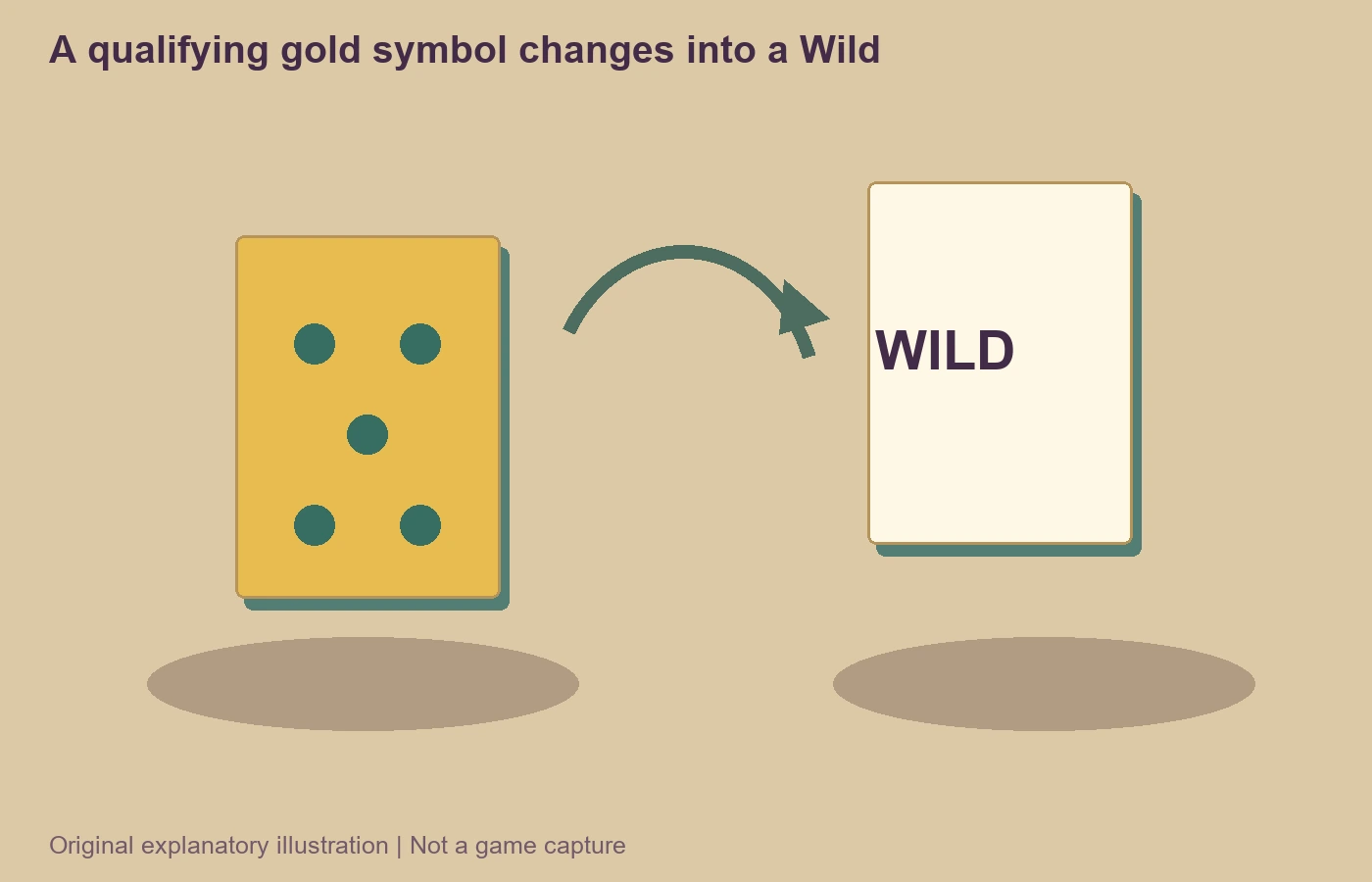
Gold-plated symbols can appear on the three middle reels, excluding Wild and Scatter symbols. Section 2.3 explains that a gold-plated symbol involved in a win transforms into a Wild in the new round after replacement symbols have cascaded down. The condition involves both the symbol’s gold state and its involvement in the preceding win. [mahjong-pdf: sections 2.2–2.3]
- Reading the illustration
The second illustration places an original gold tile beside a separate Wild tile, with a curved movement cue between them. It is a close view of two physical-style objects rather than a second reel display. The visual separation prevents gold from being treated as a synonym for Wild before the transformation condition has been satisfied.
- Interpreting the state
The document says that Wild substitutes for symbols other than Scatter. That exception is important when reading a busy image: a Wild should not be counted as a substitute for a missing feature-trigger Scatter. The terminology identifies different roles, even if both symbols are visually prominent. A caption that simply calls them “special tiles” would hide the distinction. [mahjong-pdf: section 2.2]
- Rule boundary
For a careful description, name the gold tile, identify its participation in the completed winning arrangement and then describe the later Wild state. This keeps the order of events intact. A still drawing cannot establish the exact result credited by a real implementation, but it can explain why a before-and-after account needs two separate states.
Read the multiplier sequence in its own phase
- Documented definition
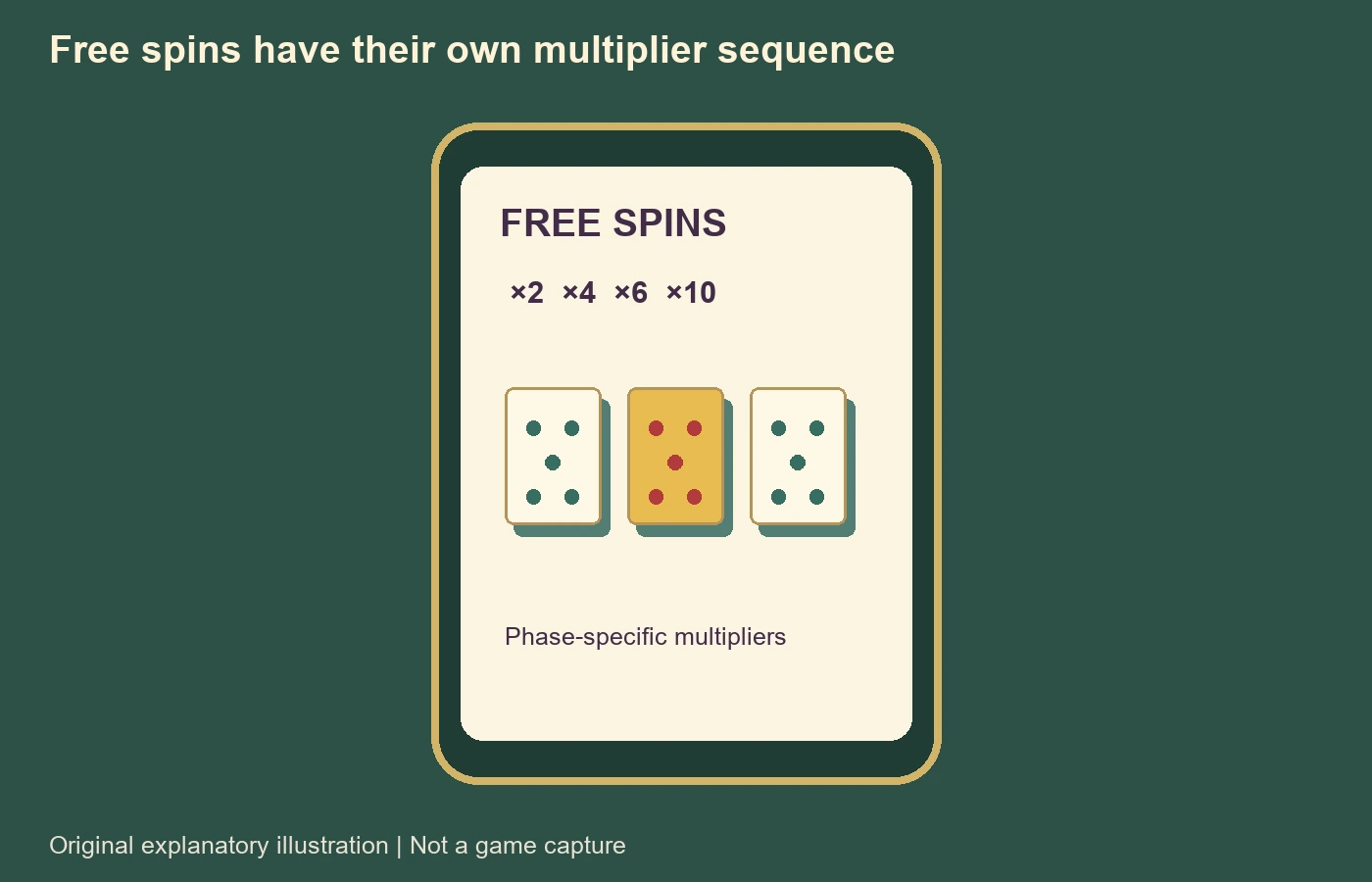
The base sequence begins at one and advances through two, three and five as wins continue through successive rounds. In the free-spin feature, the corresponding values are two, four, six and ten. The document gives these as separate sequences, so the phase must be named before interpreting the visible multiplier. [mahjong-pdf: sections 2.4–2.5]
- Reading the illustration
Our conceptual phone shows the free-spin multiplier labels above a small illustrated tile fragment. It demonstrates where the phase and its factor belong in a reading note. The arrangement is invented for this article and does not claim that PG SOFT or every operator uses this exact screen layout. No wallet, active spin control or transaction is depicted.
- Interpreting the state
A multiplier factor is not a freestanding award. It modifies the relevant win under the applicable rules. Without identifying that underlying result, quoting the largest factor would provide an incomplete description. The feature’s upper factor also says nothing about how frequently a reader would encounter it. This article reports the sequence without offering a method to reach it.
- Rule boundary
The official news item highlights an increased multiplier during free spins and the gold treatment of ordinary symbols on reel three. The more detailed PDF supplies the exact progression and its transformation timing. Using the announcement for the broad feature and the versioned document for the detailed rule keeps the sources’ different levels of detail visible. [mahjong-news][mahjong-pdf]
Distinguish Scatter counts from symbol substitution
- Documented definition
Three Scatters appearing anywhere trigger ten free spins, and each additional Scatter adds two. The same versioned document says that free spins can be retriggered. During the feature, ordinary symbols on reel three appear in gold, with Wild and Scatter excluded from that treatment. These are linked feature rules, but they describe different objects and should be stated separately. [mahjong-pdf: section 2.5]
- Reading the illustration
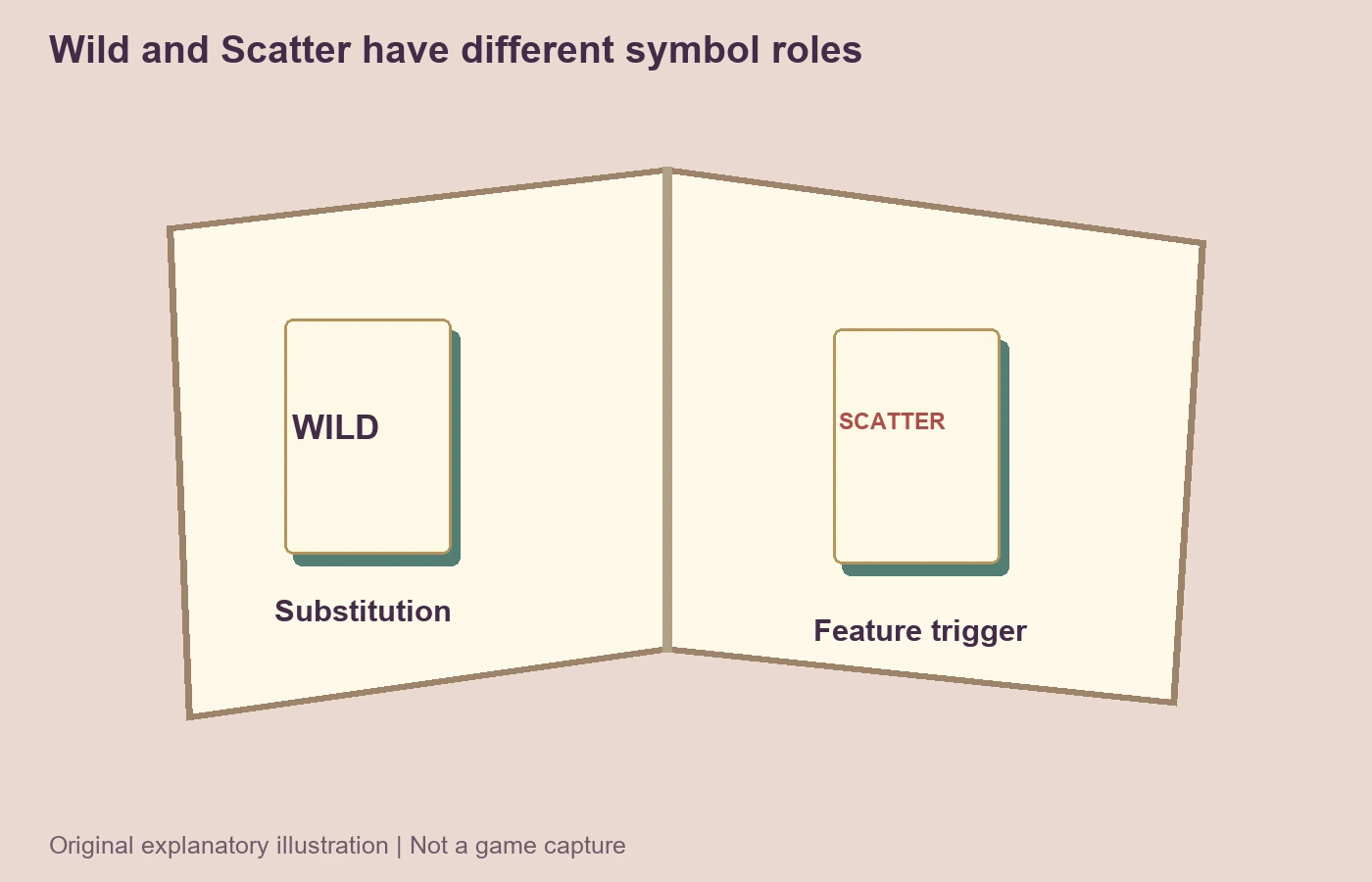
The open paytable-style book in our fourth illustration contains original tile drawings, separate Wild and Scatter headings and no numeric award schedule. It helps a reader locate the three symbol roles. The book is an original explanatory prop, not a scan of PG SOFT’s document and not a claim that the fictional page is an official rules sheet.
- Interpreting the state
The absence of money values is deliberate. A teaching image can clarify categories without reproducing a complete operator-specific configuration. Where a rule depends on the exact deployed version, the applicable in-game rules should be checked against that version. A local illustration cannot establish a stake range, an operator’s currency setting or an account settlement.
Reference questions
Is Mahjong Ways 2 a game of table mahjong?
The official material describes a video slot using mahjong imagery. This reference concerns its reel layout, symbol transformation and feature states, rather than the hand-building rules of a table mahjong match. Familiar-looking tiles do not make those rule systems interchangeable.
Can a Wild replace a Scatter?
Section 2.2 of version 1.0r792 says Wild substitutes for symbols except Scatter. The two categories therefore remain separate in our diagrams. A Wild is not counted as a missing Scatter merely because both are prominent special symbols.
When does a gold-plated symbol transform?
Section 2.3 ties transformation to a gold-plated symbol involved in a preceding win, with the Wild appearing in the new round after symbols cascade. Gold appearance alone is not described here as unconditional immediate transformation.
Which document version supports the numerical details?
The archived English Game Information PDF identifies version 1.0r792 and prints Latest Update 08/07/2025. We preserve that field as printed. The article does not claim that the document establishes the configuration deployed by every operator.