Sugar Rush 1000: Symbols and Feature Reference
Sugar Rush 1000 uses connected groups on a seven-by-seven grid, then removes winning candies so new symbols can fall into their places. Its distinctive feature belongs to the positions underneath those symbols: repeated winning activity can turn a marked location into a multiplier spot. This reference separates the visible candies, the persistent locations and the free-spin rules described in Pragmatic Play’s own material. [sugar-product]
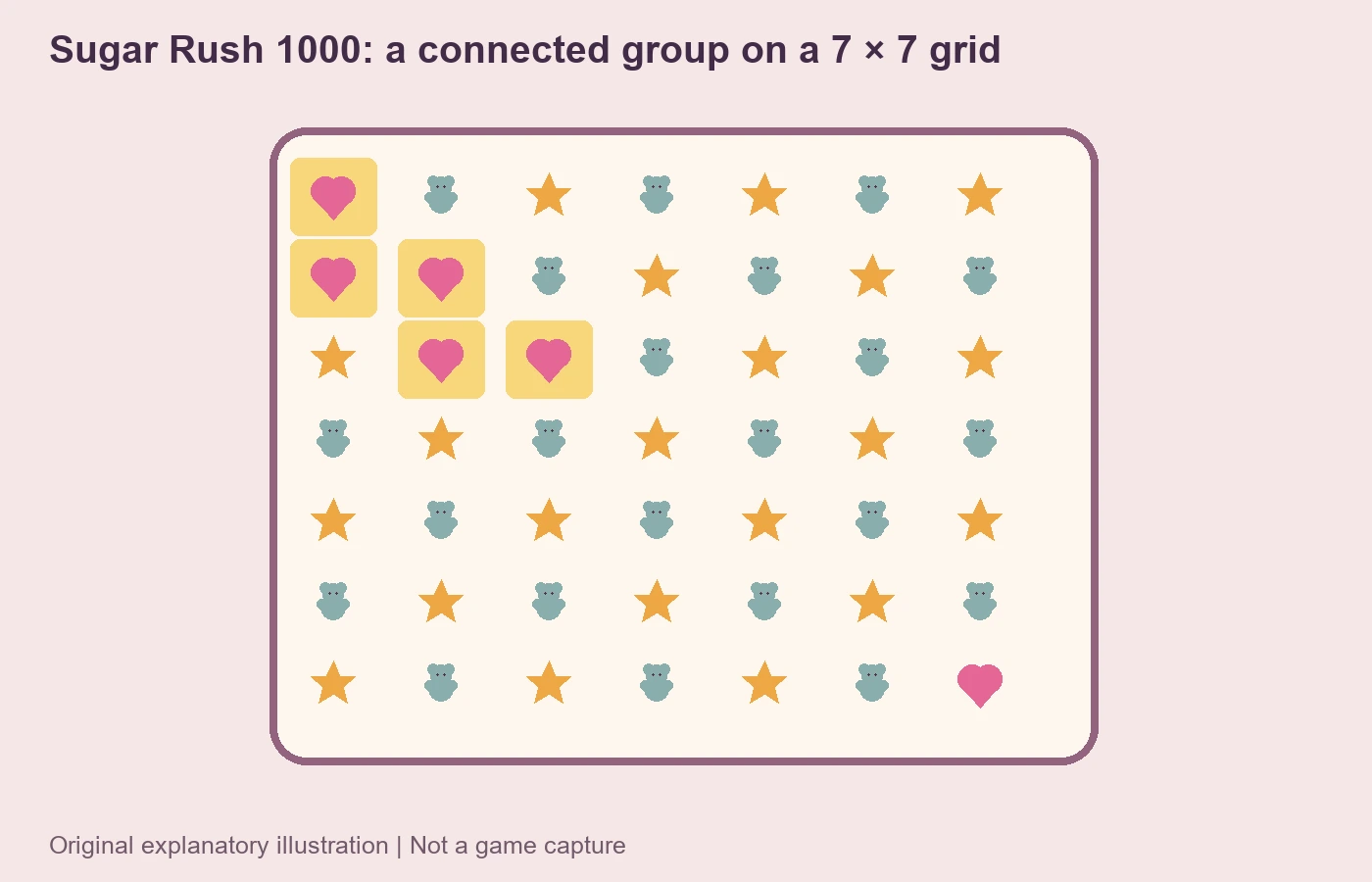
Find the cluster before following a line
A winning group needs at least five matching adjacent symbols, according to the official product description. The important reading task is therefore to identify connected matching candies rather than trace a fixed payline from one side of the display to the other. Jelly bears, hearts and stars are among the symbol subjects named by the developer. The illustration uses original candy drawings to explain adjacency; it does not reproduce the publisher’s artwork. [sugar-product]
In our imaginary grid, five pink hearts share edges. A separate pink heart elsewhere on the board is deliberately left outside the highlighted group. Counting every pink object in the picture would answer a different question from identifying the connected group. This is a useful distinction when describing a crowded display: the symbol type tells you what matches, while the arrangement tells you which matching symbols belong together.
The drawing also includes shapes that have no highlight. Their presence is part of the visual explanation, rather than a suggestion that they are about to complete another combination. A static teaching picture has no hidden next spin. It can demonstrate a relationship between visible objects without providing a probability, a prediction or a record of an actual game event.
The paytable remains the place for the applicable symbol values. Neither the number of decorated sweets in a promotional picture nor the size of an illustration establishes an amount. A reference that identifies the matching rule can still leave the monetary calculation to the actual, version-specific information screen. This article does not invent a replacement payout table.
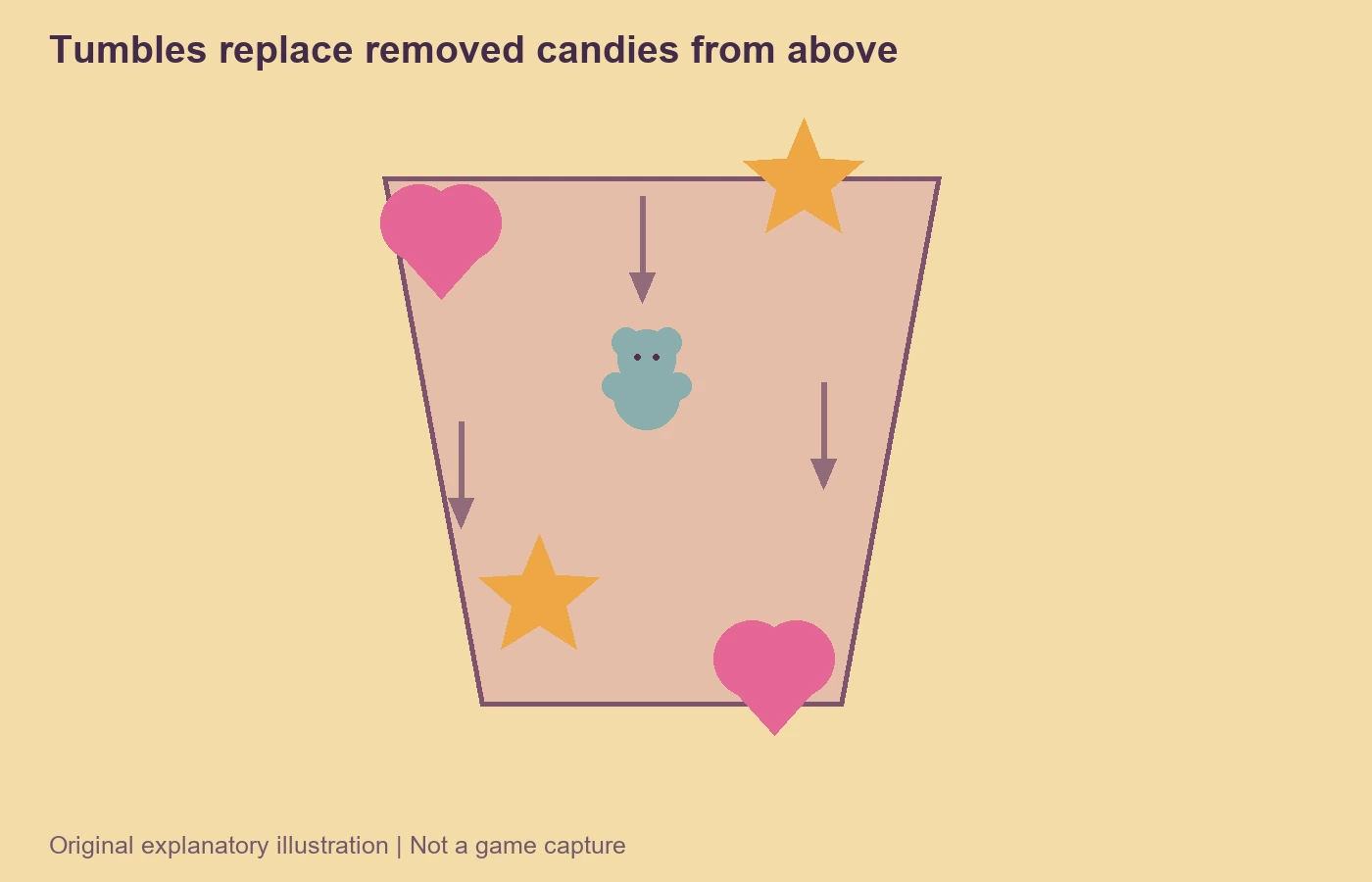
Watch empty positions during a tumble
A tumble removes a winning group and fills the resulting gaps from above. Further winning groups can continue that sequence until no more wins appear, as the developer describes. The falling-candy illustration isolates this movement: an upper sweet, an empty space and a lower resting position are shown at different heights, with no spin button or account balance. [sugar-product]
A sequence is easier to describe when the positions and the objects have separate names. “The candy disappeared” identifies a symbol event. “The gap was filled” describes what happened to a location. Those two observations become especially important in this title because the multiplier feature tracks locations on the board. Treating every falling symbol as if it carried its earlier position with it would make that feature harder to understand.
The drawing is intentionally a close view of falling objects rather than a second full grid. It explains vertical replacement without pretending to show all forty-nine positions at once. No speed, animation duration or number of successful tumbles is implied. A paused image cannot establish how often another winning group will form after a refill.
For an accessible written description, name the completed group first, then the spaces it leaves, then the new arrangement. This order lets a reader follow the change without relying on colour alone. Shape words such as heart and star remain useful where a small phone display makes neighbouring shades difficult to distinguish.
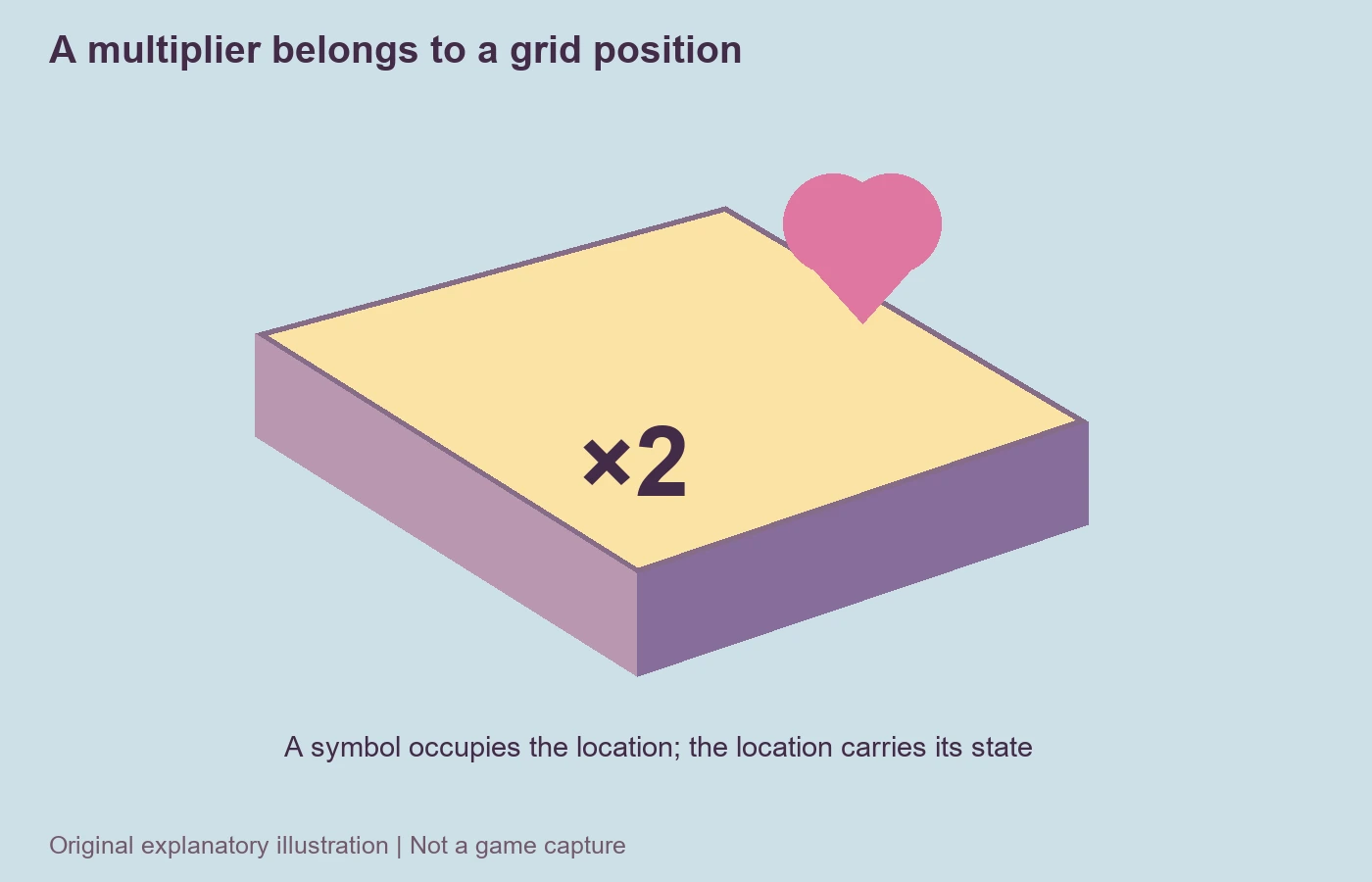
Read a multiplier as a property of a spot
The multiplier spot is attached to a grid location, rather than to a candy that can move away. The official description explains that an initial winning removal marks a spot; another winning removal at that spot adds a multiplier starting at two, with later increases doubling up to the published limit of 1,024. These are feature limits, not promises about what a particular sequence will produce. [sugar-product]
Our close-up uses a single raised tile with a two-times marker and a translucent candy above it. The two objects are deliberately distinct. The tile represents the location’s feature state; the sweet represents a symbol occupying that location. The picture supplies no amount and therefore cannot be read as a completed payout calculation.
A multiplier label and a symbol value also answer different questions. The label identifies a factor associated with the feature, while the paytable supplies the underlying combination value and the applicable rules describe how the feature is applied. Reading only the largest visible number would discard that context. The article avoids supplying an improvised formula for a combination spanning several marked positions because the short public product description is not a complete settlement manual.
The practical editorial distinction is between identifying a state and proving a result. A visible marked spot can be described as marked. Establishing the amount credited for a completed sequence requires the actual rule explanation and result record for the deployed game. A promotional maximum alone cannot supply those missing details.
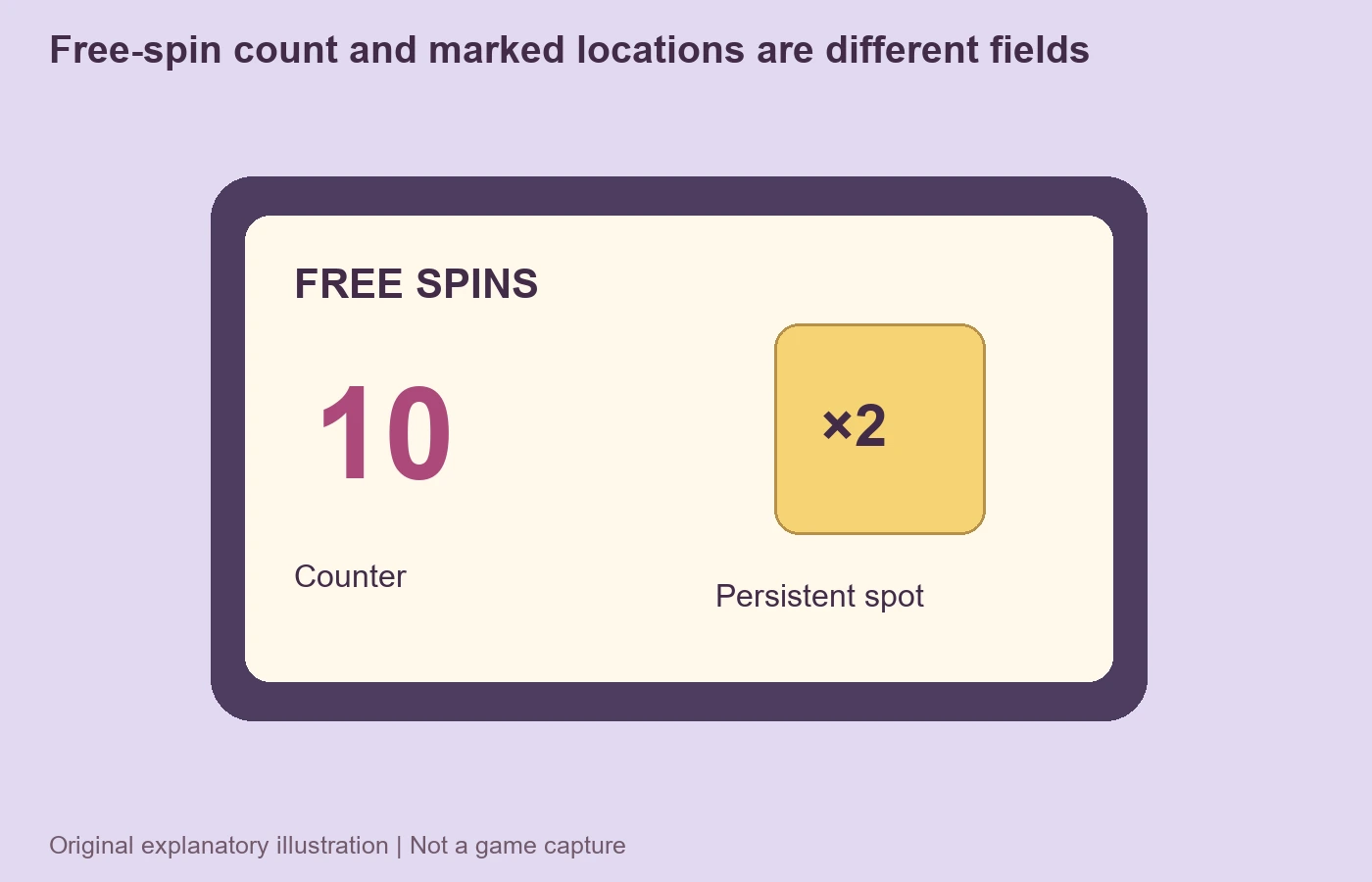
Separate the free-spin counter from persistent marks
The launch announcement provides a specific scatter schedule: three, four, five, six or seven scatters award ten, twelve, fifteen, twenty or thirty free spins respectively. It also describes multiplier positions remaining in place during the bonus round. The product page confirms that additional scatter appearances can award further free spins. [sugar-launch][sugar-product]
Our conceptual tablet displays a free-spin counter beside a small persistent-position marker. These are separate pieces of information. The counter concerns the number of games in the feature; the marker concerns the state carried on the grid. An increase in one does not itself explain a change in the other. This layout is an original reading aid, not a screenshot or a claim that every operator places these fields in the same corner.
The announcement’s ceiling of 25,000 times the bet describes the advertised maximum for the named release. It is not an expected return, an estimate of a normal session or evidence that a displayed sequence reached that limit. We make no recommendation based on that number. The title suffix identifies a particular release; it does not mean every multiplier or every result equals one thousand. [sugar-launch]
Keep this reference tied to the named release
Sugar Rush 1000 should be identified by its complete title before borrowing a feature description. The official launch notice is dated 18 March 2024 and presents this as a development of the original Sugar Rush. That historical notice supplies release context, while the product page supplies the current description retrieved for this reference. Neither source establishes which configuration a particular Philippine operator has deployed. [sugar-launch]
A useful reading note records the exact title shown, the rule edition if one is displayed and the feature being discussed. For this article, that means distinguishing cluster formation, replacement by tumbles, marked locations and the bonus counter. Keeping those categories separate makes a screenshot caption more precise without adding speculation about the next outcome. The four original illustrations each explain one of those categories and are not evidence of gameplay testing.
Describe one location without losing the sequence
A simple coordinate can make a written explanation unambiguous. In an invented classroom note, call the centre location D4 and describe its state at two separate pauses. The first note concerns the candy at D4; the second concerns the mark left underneath it. The coordinate remains the same even if the occupying symbol changes. These labels belong to our explanatory drawing, not an additional named feature in the game.
This notation is useful when several matching groups appear close together. A caption can identify the chosen location without claiming that every visible spot has the same history. It also avoids relying on a colour word such as pink, which could describe either a candy or a highlight. The result is a description of a particular relationship between symbol and position, rather than an invented account of an entire round.
FAQ
Does Sugar Rush 1000 use a fixed payline in this description?
The official product page describes clusters of at least five matching adjacent symbols. This reference therefore explains connected groups rather than a fixed line traced across the display. The applicable paytable supplies the values; our illustrative grid does not supply an award.
Does the multiplier travel with a candy?
The developer describes multiplier spots on the grid. Our diagram separates the occupying sweet from the position underneath it to explain that distinction. It is an original illustration of the stated feature, without a live result, account amount or claim about a later arrangement.
What does the scatter schedule describe?
The release announcement gives awards of ten, twelve, fifteen, twenty and thirty free spins for three through seven scatters respectively. These are conditions for the named release, rather than a prediction about when a feature will occur.
Was this article based on a played session?
No. The reference is based on the developer’s product description and separate launch notice. The pictures are original explanatory artwork, and no gameplay sample, payment operation or performance test is claimed.